Cycling: The Runner's Secret Weapon
You don't have to love Lycra. But adding a bike to your training might be the easiest way to build fitness without beating up your legs.
Here's a dirty secret from the endurance world: some of the fittest runners you know got that way on a bike. Not by running more. Not by running harder. By pedalling.
Cycling builds the same aerobic engine as running — bigger heart, more mitochondria, better fat oxidation — but without the impact. Zero ground strikes. Zero eccentric loading. Just smooth, low-stress cardio that your joints barely notice.
Same engine, different vehicle
Your cardiovascular system doesn’t care whether you’re running or cycling. It responds to time at an elevated heart rate. An hour in Zone 2 on the bike builds aerobic fitness just like an hour in Zone 2 on the road — minus the 90,000 foot strikes.
That’s the trade-off in a nutshell. You can accumulate more total training volume — more hours, more aerobic work — without increasing injury risk, because the bike doesn’t break you down the way running does.
If you're running 4 hours a week and can't add a 5th run without getting hurt, add a bike ride instead. You get the aerobic benefit of a 5th session without the mechanical cost. Your legs stay fresh for the runs that matter.
The commute that counts
You don’t need a road bike and a 3-hour weekend ride. For most runners, the easiest cycling to add is the kind you’re already sort of doing: commuting.

A 15-minute bike commute, twice a day, four days a week? That's 2 hours of Zone 1-2 aerobic work baked into your week with zero extra time commitment. I count it in your load chart. It adds up faster than you think.
It doesn’t have to be intense. Commute-pace cycling sits in Zone 1-2 naturally — you’re not trying to set any records, you’re just getting somewhere. But those easy aerobic minutes compound over weeks and months.

When to ride with purpose
Beyond commuting, there are two types of bike sessions worth adding to a runner’s week:
The long easy ride
When: Weekend, instead of a second long run or on a recovery day. How long: 60-90 minutes at conversational effort. Why: Massive aerobic stimulus with almost no recovery cost. You can run again the next day feeling fresh.
The high-cadence spin
When: The day after a hard run, as active recovery. How long: 30-40 minutes, easy resistance, high cadence (90+ rpm). Why: Flushes the legs, promotes blood flow, speeds recovery — without the pounding of an easy jog.
No bike? A stationary bike or spin bike at the gym does the same job. The scenery is worse but the training stimulus is identical. Put on a podcast and spin for 45 minutes. Your aerobic system won't know the difference.
The specificity argument
“But cycling isn’t running.” True. And this matters. Cycling builds general aerobic fitness, but it doesn’t train the running-specific adaptations: ground contact strength, elastic tendon recoil, running economy.
You can’t replace running with cycling and expect to race well. But you can supplement running with cycling and race better — because you arrive at the start line with a bigger aerobic base and fresher legs.
| What cycling builds | What it doesn’t build |
|---|---|
| Aerobic capacity (VO2max) | Running economy |
| Fat oxidation | Ground contact strength |
| Cardiac output | Elastic tendon recoil |
| Leg muscular endurance | Running-specific neuromuscular patterns |
| Mental toughness (long rides) | Confidence at race pace |
Cycling is an addition, not a substitution. Don't drop a key running session to ride instead — add riding on top of or between your runs. The runs build running fitness. The bike builds the engine underneath.
How Flott handles multi-sport
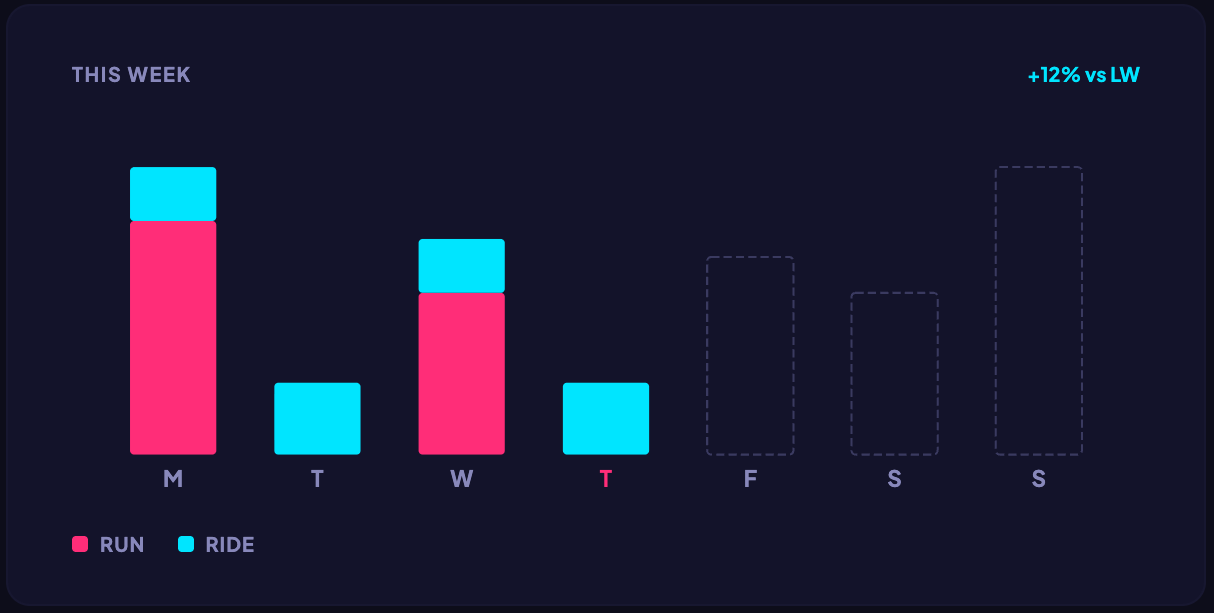
Flott tracks cycling and running as separate sports with their own accent colours — cyan for cycling, pink for running. Your weekly load chart shows both, so you can see the total stress on your body, not just the running portion.

Your running load this week is 180. Your cycling adds another 60. Total: 240. That's 15% above last week — which is fine, because the cycling portion has almost no impact cost. If that extra 60 was running, I'd be flagging it.
Flotti understands that 60 points of cycling load doesn’t stress your body the same way as 60 points of running load. The volume counts, but the mechanical cost is different. That nuance matters when planning recovery.
Cycling builds the same aerobic engine as running — without the impact. Add a commute, a weekend ride, or a recovery spin to your week and you'll build more fitness with less injury risk. It's not a replacement for running. It's the force multiplier beside it.

The Flott Blog
Training smarts, dev stories, and Flotti opinions.